

In recent years, there has been a significant advancement in the field of Artificial Intelligence (AI) and Augmented Reality (AR). These technologies have become increasingly popular and have the potential to enhance virtual experiences in various fields such as gaming, education, healthcare, and...
A Neural Network Helps Dermatologists Distinguish Melanoma from Benign Moles
21
14.10.2026
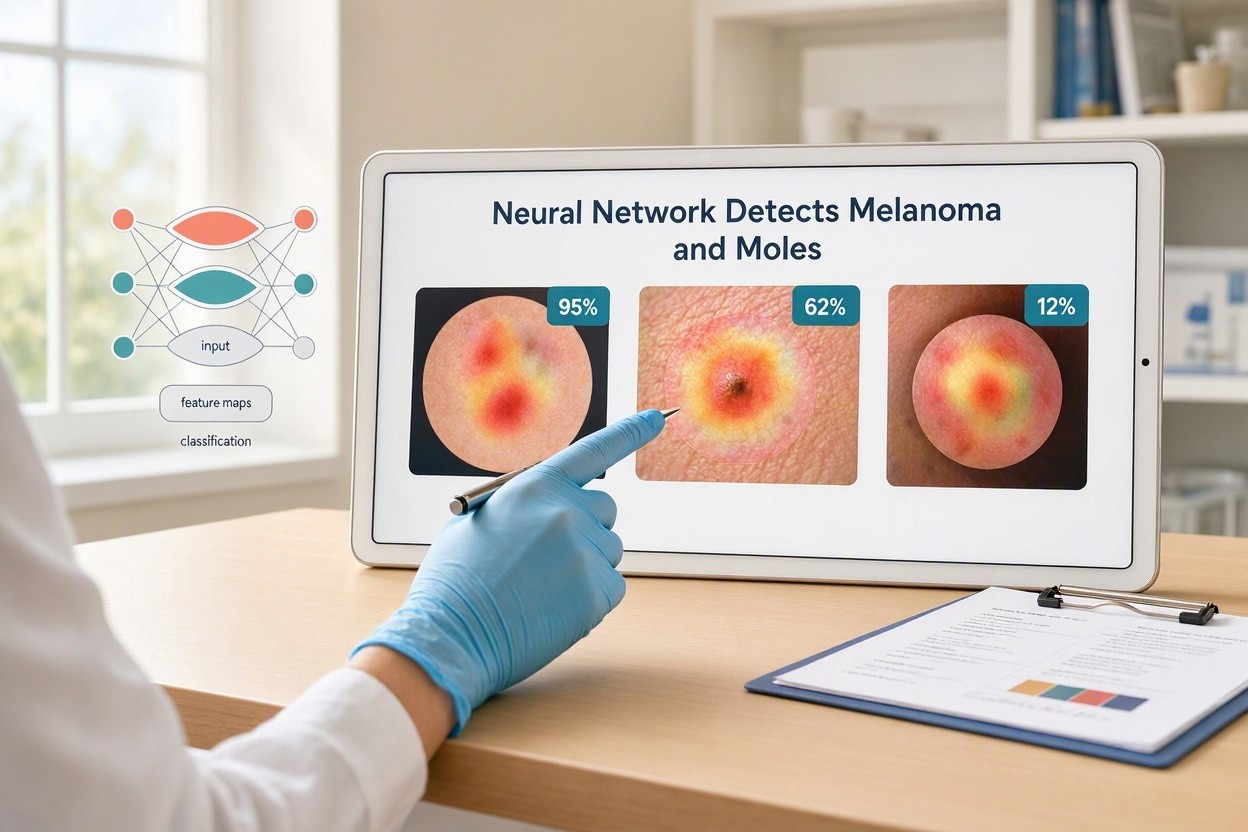
Melanoma is one of the most dangerous forms of skin cancer because it can spread quickly if it is not detected early. At the same time, many harmless moles may look unusual, especially to the naked eye. This creates a difficult clinical challenge: dermatologists must identify dangerous lesions without causing unnecessary anxiety or excessive biopsies. Today, neural networks are becoming valuable diagnostic support tools, helping specialists distinguish melanoma from benign moles with greater consistency.
Why Melanoma Diagnosis Is So Challenging
Dermatologists traditionally examine suspicious skin lesions using visual assessment, dermoscopy, patient history, and, when necessary, biopsy. The well-known ABCDE rule helps evaluate asymmetry, border irregularity, color variation, diameter, and evolution. However, real-world lesions are not always textbook examples. Early melanomas may appear subtle, while benign nevi can sometimes display alarming features.
Diagnostic accuracy also depends on experience. A specialist who sees thousands of pigmented lesions each year may recognize patterns that a less experienced clinician could miss. This is where artificial intelligence can help: not by replacing the dermatologist, but by adding a second analytical perspective based on large volumes of image data.
How Neural Networks Analyze Skin Lesions
A neural network is a type of machine learning model designed to detect patterns in complex data. In dermatology, convolutional neural networks are commonly used because they are especially effective for image analysis. These systems can be trained on thousands or even millions of clinical and dermoscopic images labeled as melanoma, benign nevus, seborrheic keratosis, or other skin conditions.
Image Recognition at a Microscopic Level
When a dermatologist reviews a mole, they assess visible structures such as pigment networks, dots, streaks, blue-white veils, and vascular patterns. A neural network also evaluates visual features, but it does so mathematically. It analyzes shapes, color gradients, textures, edges, and spatial relationships across many layers of computation. Some of these patterns may be too subtle for the human eye to quantify reliably.
Training on Verified Medical Data
The quality of an AI diagnostic tool depends heavily on the quality of its training data. Reliable systems are trained with images linked to confirmed diagnoses, preferably verified by histopathology after biopsy. Diverse datasets are also essential. A model should include different skin tones, age groups, lesion locations, camera types, and clinical settings to reduce bias and improve general performance.
Benefits for Dermatologists and Patients
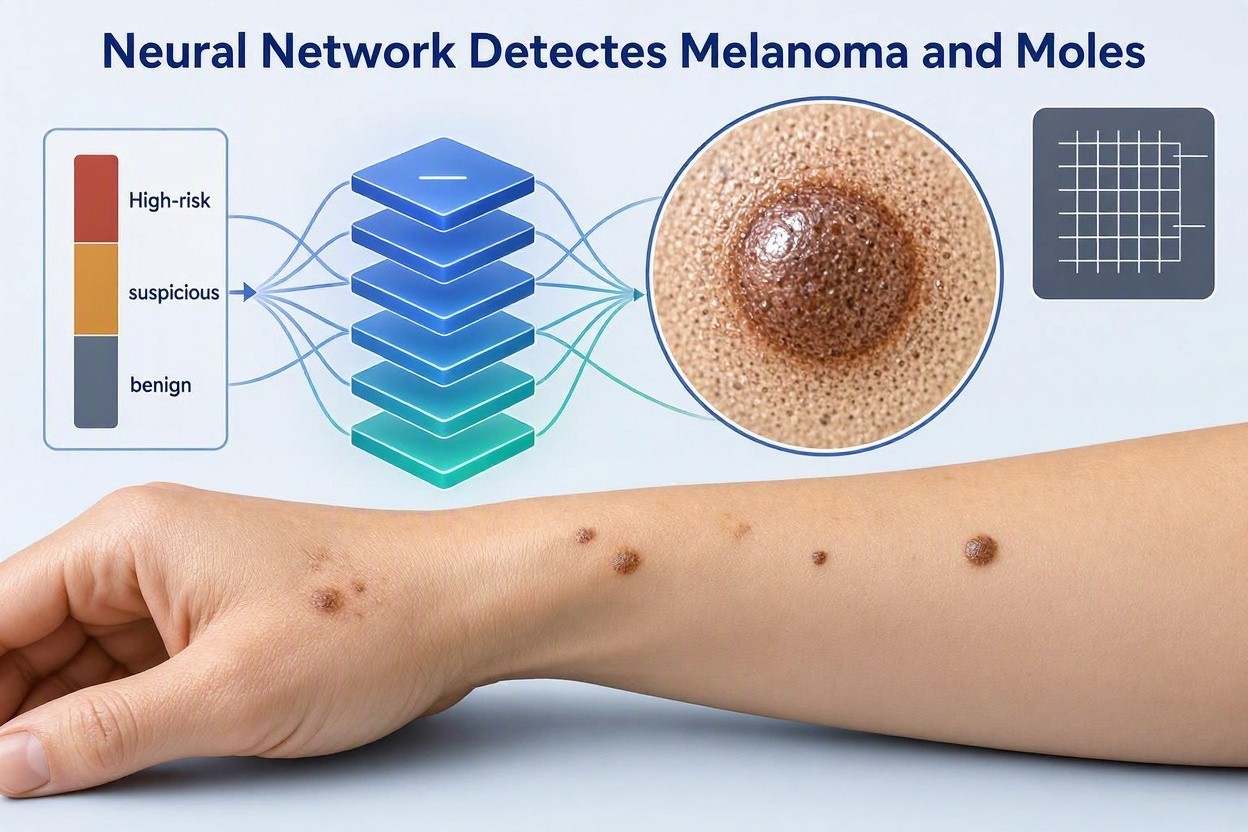
Neural networks can support melanoma detection in several practical ways. They can help prioritize high-risk lesions, assist in teledermatology consultations, and provide decision support during routine skin examinations. For patients, earlier identification of melanoma may lead to faster treatment and better outcomes.
- Improved triage: AI can flag lesions that need urgent specialist review.
- Greater consistency: Algorithms apply the same analytical criteria to every image.
- Support for less experienced clinicians: Decision tools can provide guidance in primary care or remote settings.
- Reduced unnecessary biopsies: Better risk assessment may help avoid removing clearly benign lesions.
Use in Teledermatology
Teledermatology has expanded rapidly, especially in regions where access to specialists is limited. A patient or clinician can capture an image of a suspicious mole and submit it for remote review. Neural networks can help sort cases by risk level, allowing dermatologists to focus first on lesions that appear most concerning. This does not eliminate the need for expert review, but it can make the process faster and more efficient.
Limitations and Clinical Responsibility
Despite impressive progress, AI tools are not perfect. Image quality, lighting, focus, and lesion positioning can affect results. Some melanomas, such as amelanotic melanoma, may lack dark pigment and be harder for both humans and algorithms to recognize. In addition, an AI model trained mainly on one population may perform less accurately in another.
For this reason, neural network output should be treated as clinical support rather than a final diagnosis. A dermatologist must consider the full context: changes over time, symptoms such as itching or bleeding, family history, immune status, and the patient’s overall risk profile. If a lesion is suspicious, biopsy remains the diagnostic gold standard.
Ethical and Data Privacy Considerations
Medical AI also raises important questions about privacy, transparency, and accountability. Skin images are personal health data and must be stored and processed securely. Patients should understand how their images are used, especially if data contribute to future model training. Clinicians also need clear information about an algorithm’s performance, limitations, and validation studies.
The Future of AI-Assisted Skin Cancer Detection
The most promising future is not a competition between dermatologists and machines, but a partnership. Neural networks can rapidly analyze visual patterns, while dermatologists bring medical judgment, patient communication, and ethical responsibility. As datasets become more diverse and validation becomes stronger, AI may become a routine part of skin cancer screening.
For now, patients should continue regular skin self-examinations, monitor changing moles, and seek professional evaluation for any suspicious lesion. A neural network can help dermatologists distinguish melanoma from benign moles, but early attention and expert care remain the foundation of effective skin cancer prevention.