

In recent years, there has been a significant advancement in the field of Artificial Intelligence (AI) and Augmented Reality (AR). These technologies have become increasingly popular and have the potential to enhance virtual experiences in various fields such as gaming, education, healthcare, and...
AI Selects Concrete Compositions Suited to Regional Climate
15
16.10.2026
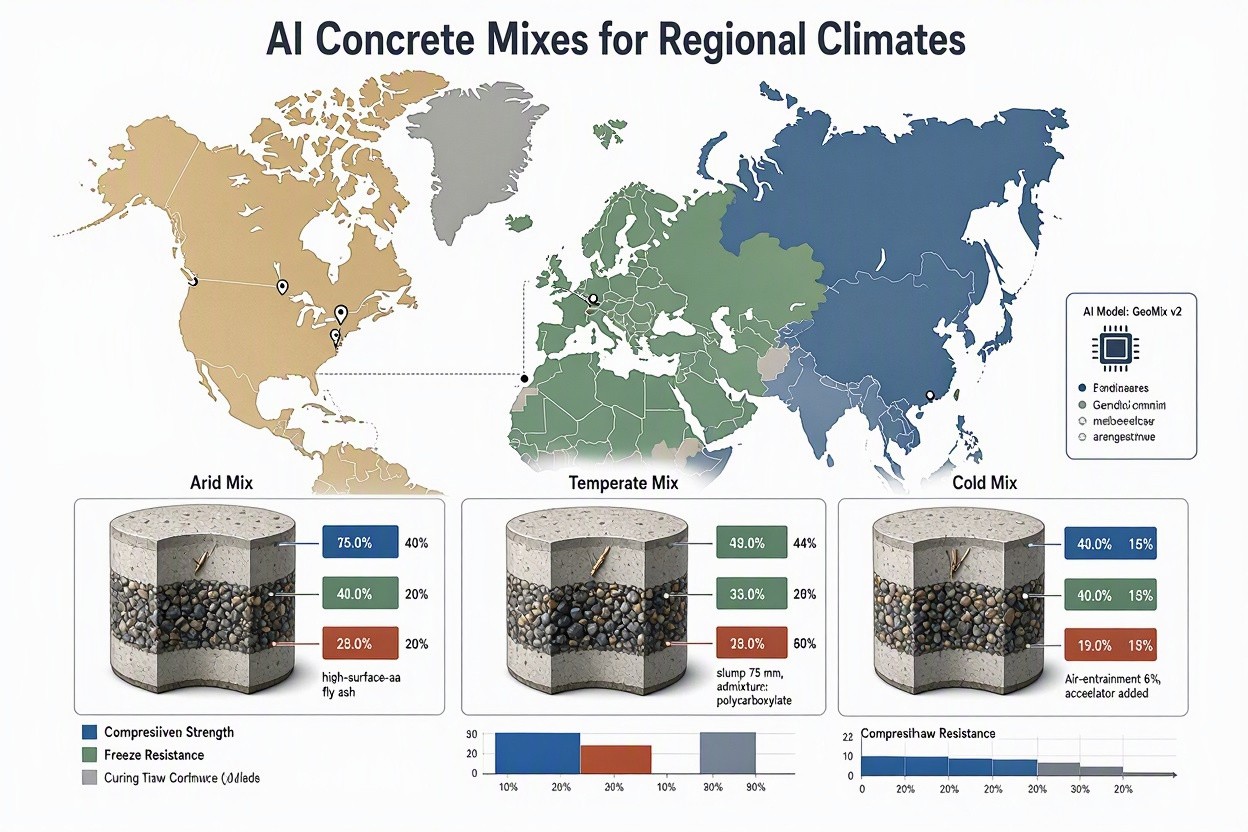
Concrete that performs well in one region can fail early in another. Heat, frost, humidity, wind, salt exposure, rainfall patterns, and local raw materials all influence strength development and long-term durability. Artificial intelligence is changing how engineers respond to these variables. Instead of relying only on standard mix tables and repeated trial batches, AI systems can analyze climate data, material properties, project requirements, and performance history to recommend concrete compositions tailored to a specific location.
Why Climate-Specific Concrete Matters
Concrete is not a single universal product. It is a controlled system of cement, supplementary cementitious materials, aggregates, water, admixtures, and air voids. The same water-cement ratio or cement type may behave differently in a dry desert, a coastal city, a high-altitude region, or an area with severe freeze-thaw cycles.
Common climate-related risks
- Hot and dry climates: rapid water loss, plastic shrinkage, thermal cracking, and reduced workability.
- Cold regions: slow hydration, frost damage, delayed strength gain, and scaling from deicing salts.
- Coastal environments: chloride penetration, reinforcement corrosion, and sulfate attack.
- Humid tropical zones: high permeability risks, biological staining, and extended curing challenges.
- Regions with large temperature swings: internal stress, cracking, and durability loss over time.
When the mix is not adjusted for these conditions, structures may require expensive maintenance long before the end of their design life. AI helps reduce this risk by connecting environmental exposure with measurable material behavior.
How AI Designs a Regional Concrete Mix
An AI-driven mix design platform works by learning from large datasets: laboratory test results, field performance records, weather history, standards, material certificates, and sensor data from active construction sites. Machine learning models then predict how different proportions will perform under local conditions.
Key inputs used by the model
- Regional temperature ranges, humidity, rainfall, freeze-thaw frequency, and solar exposure.
- Exposure class, including chlorides, sulfates, abrasion, carbonation risk, and chemical attack.
- Available cement types, aggregates, fly ash, slag, silica fume, limestone filler, and recycled materials.
- Required compressive strength, setting time, pumpability, slump retention, and finish quality.
- Project constraints such as budget, delivery distance, curing method, and carbon targets.
Using these inputs, the system can recommend a mix that balances strength, durability, constructability, and sustainability. It may suggest lower water content with a high-range water reducer for hot climates, air entrainment for freeze-thaw resistance, or supplementary cementitious materials to reduce permeability in marine environments.
Practical Recommendations by Climate Type
Hot and arid regions
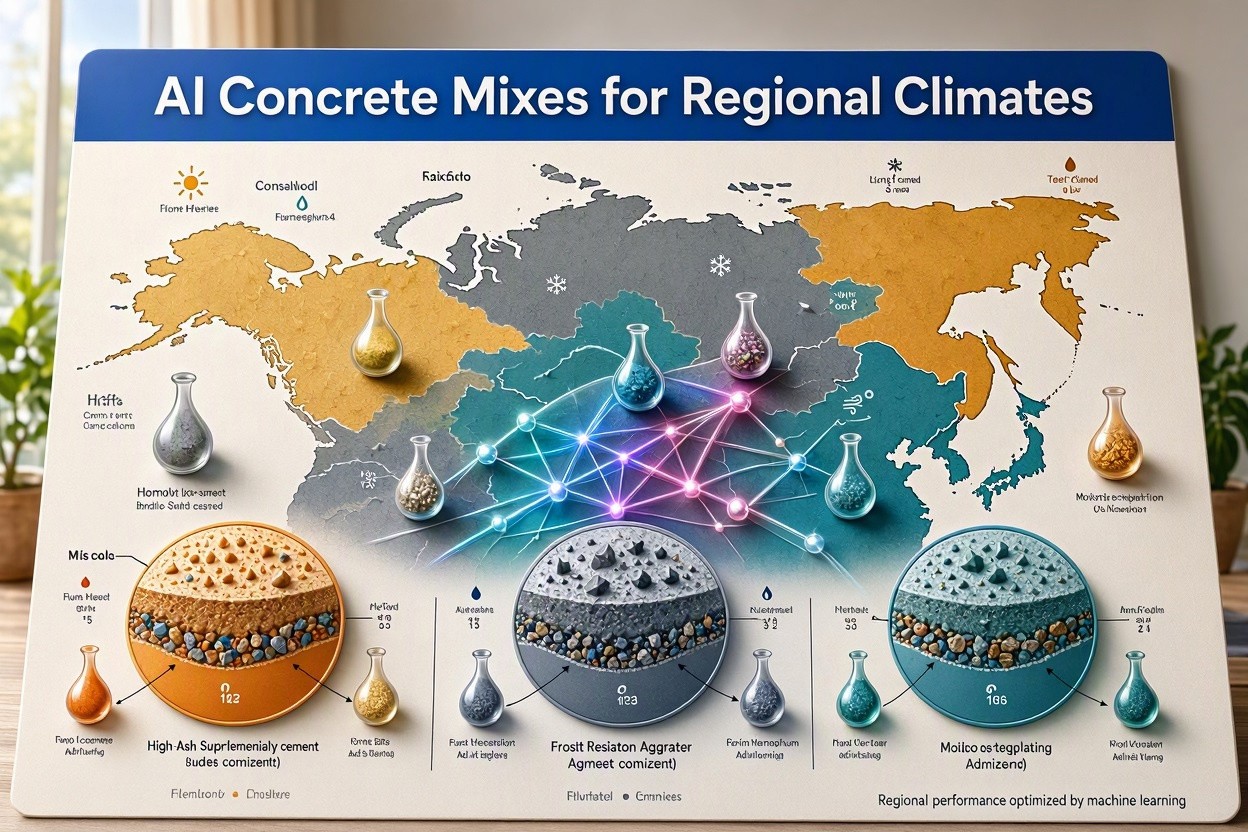
In desert or semi-desert areas, AI often prioritizes slump retention, controlled heat of hydration, and reduced evaporation. It may recommend retarding admixtures, optimized aggregate gradation, chilled mixing water, or partial cement replacement to limit thermal cracking. The model can also propose ideal pouring windows, such as early morning or evening, based on forecast data.
Cold and freeze-thaw regions
For cold climates, the focus shifts to early strength, frost resistance, and air-void stability. AI can select air-entraining admixtures, accelerators, and cementitious combinations that perform reliably at low temperatures. It can also estimate when concrete will reach critical strength before exposure to freezing, improving planning and site safety.
Coastal and high-humidity regions
Near the sea, durability depends heavily on low permeability and resistance to chloride ingress. AI may favor slag, fly ash, silica fume, corrosion inhibitors, or lower water-cement ratios. In humid regions, the system can also account for slower drying, curing efficiency, and the risk of long-term carbonation.
Benefits for Contractors, Engineers, and Owners
Climate-adapted AI mix design offers more than technical precision. It can shorten the testing phase, reduce material waste, and improve quality consistency across batches. Contractors benefit from better workability at the jobsite, engineers gain more reliable performance predictions, and owners receive structures with a longer service life.
Another important advantage is carbon optimization. AI can identify where cement content can be safely reduced and replaced with locally available supplementary materials without compromising performance. This is especially valuable as infrastructure projects face stricter environmental requirements.
Limits and Best Practices
AI should not replace professional engineering judgment. Its recommendations must be verified through laboratory testing, local standards, and field trials. The quality of the output depends on the quality of the data. Poor aggregate characterization, outdated climate records, or untested admixture interactions can lead to unreliable predictions.
Effective implementation requires
- Accurate local material testing before model calibration.
- Compliance with regional building codes and exposure classifications.
- Trial batches to confirm strength, setting behavior, and durability indicators.
- Ongoing monitoring using sensors and quality control data.
The Future of Climate-Responsive Concrete
As climate patterns become less predictable, concrete design must become more adaptive. AI makes it possible to move from generic mix prescriptions to data-informed compositions that reflect the real environment surrounding a structure. When combined with engineering expertise, local testing, and responsible material selection, AI can help produce concrete that is stronger, longer-lasting, and better suited to the climate of each region.